
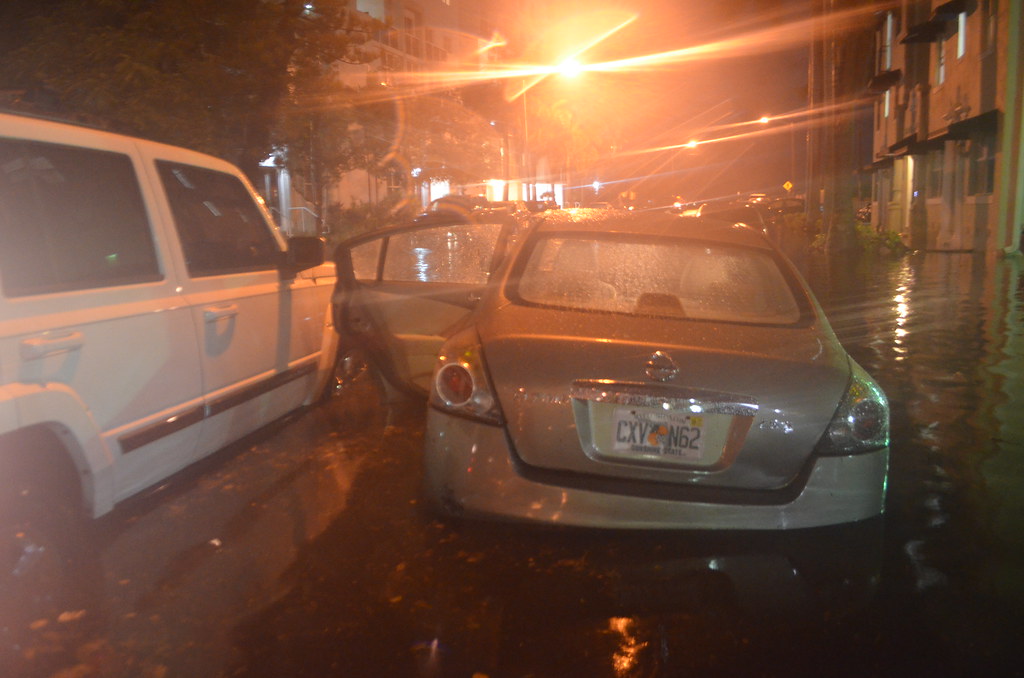
On a day of torrential rain, a car parked below an apartment retaining wall was submerged and had to be scrapped. Yet the apartment complex says it bears no responsibility. This is the story reported by Inews24, citing the YouTube channel Han Moon-cheol TV. At around 6 a.m. on August 17, in a parking lot below the retaining wall of an apartment complex in Okpo-dong, Geoje, South Gyeongsang Province, water from the retaining wall came pouring down all at once in the heavy rain. The water, falling from a height of about six meters, engulfed a silver sedan parked below, filled the interior, and in the end the owner had to scrap the car.
The management office's position is as follows. The chair of the residents' council and the security guard on duty had diligently cleaned the drains in preparation for the heavy rain, and the damage was an unforeseeable, unavoidable accident caused by the rain. The owner also bore responsibility, it said, for not moving the car despite receiving several heavy-rain disaster alerts, and the City of Geoje, which built the parking lot there, should be held responsible as well. Attorney Han Moon-cheol, on the other hand, took the view that cleaning the drains was not enough and that a drainpipe should have been installed to carry the water safely downward, so the apartment side bore the greater share of responsibility.
If rain is the cause, is no one to blame? The law has a clearer standard for this question than one might expect.
1. What the Law Asks About Is Not the "Rain" but the "Facility"
A. The structure of liability for structures
Article 758(1) of the Civil Act provides that when damage is caused to another person by a defect in the installation or preservation of a structure, the possessor of the structure shall compensate for the damage. If the possessor has exercised the care necessary to prevent the damage, then the owner is liable next. A retaining wall, a drain, and a drainpipe are all structures. If they are common facilities within an apartment complex, the party that manages those facilities is highly likely to be the primary liable party as the possessor.
What stands out about this liability is that the owner's liability does not require negligence. The possessor has a way out by proving that it exercised due care, but the owner cannot raise such a defense. The victim, however, also has something to do. It is the victim who must prove that the facility had a "defect."
B. How is a "defect" determined?
A defect means a state in which the structure lacks the safety it should ordinarily possess for its intended use. The Supreme Court recently reaffirmed this standard.
Supreme Court Decision 2025Da211711, September 26, 2025
As long as a defect in a structure is one of the joint causes of an accident, the damage is deemed to have arisen from that defect, and whether a defect exists is determined by whether the party that installed or preserved the structure fulfilled the duty of protective measures required by social norms in proportion to the risk.
The first part of this ruling matters for the present case. Even if a natural phenomenon such as heavy rain is involved, if the failure of the drainage facility to do its job is one of the joint causes of the accident, liability for the structure is established. In other words, the mere fact that it rained heavily does not make the liability disappear.
2. Will the Apartment Complex's Arguments Be Accepted?
A. "We cleaned the drains"
Having cleaned the drains is a circumstance that shows management effort, but it is hard to conclude from that alone that there was no defect. The standard is not "whether you cleaned" but "whether the facility had the safety it should ordinarily have at that location." If the area below a six-meter retaining wall is used as a parking lot, the issue becomes whether equipment was needed that took into account where and how the water would drain when it rains heavily. If the structure was such that water collecting above the retaining wall simply fell straight down without a drainpipe, there is considerable room for it to be assessed as a defect.
B. "The rain was unforeseeable"
The courts do sometimes accept a force majeure claim. But the threshold is high.
Supreme Court Decision 2001Da48057, October 23, 2003
River flooding caused by rainfall with a recurrence interval of 600 or 1,000 years, exceeding the design flood level set on the basis of rainfall with a 100-year recurrence interval, was regarded as a force majeure disaster lacking both foreseeability and avoidability.
This ruling concerned river flooding, and it shows that rain must be on the order of once in several centuries before force majeure is recognized. In a situation where concentrated heavy rain recurs every summer and disaster alerts go back and forth, the claim that such rain could not have been foreseen is unlikely to be accepted. On the contrary, if the apartment side cites the disaster alerts to argue the car owner's responsibility, it may end up admitting itself that the rain was foreseeable.
C. "The owner should have moved the car"
The car owner's negligence is not a ground for eliminating liability but a ground for reducing the amount of compensation. Article 763 of the Civil Act applies the comparative negligence rule of Article 396 to tort damages. However, it is difficult for an ordinary car owner to know that a large volume of water could pour from the drain of a retaining wall. If the spot was a place where parking was normally permitted, and it was the early hours of the morning, it seems unlikely that a large share of fault would be assigned.
3. What About the City of Geoje?
A. There is a separate liability for public structures
The management office also mentioned the responsibility of the City of Geoje, which built the parking lot there. Article 5(1) of the State Compensation Act provides that when damage is caused to another person by a defect in the installation or management of a road, river, or other public structure, the State or the local government shall compensate for it. If the parking lot is a public facility installed and managed by the city, and there was a defect in its installation or management, the city can also be a liable party.
B. The facts decide whom to pursue
The issue is where the cause of the overflow lies. If the cause lies in the drainage equipment above the apartment's retaining wall, the apartment side is at issue; if it lies in the drainage or siting of the parking lot itself, the city side is at issue. If both were causes, they may be held jointly liable. From the victim's standpoint, it is worth first identifying who owns and manages the retaining wall and the parking lot and, if necessary, considering a claim against both.
4. If You Have Suffered Similar Damage
A. Secure the evidence before the rain stops
Where and how the water poured is hard to see again once the rain stops. Immediately secure photos and video of the scene, the vehicle's dashcam footage, and nearby CCTV footage. Also photograph the location of the drains and drainpipes, whether they were blocked, and the structure by which water collects above the retaining wall. Conversations or text messages exchanged with the management office and rainfall data for the relevant time period are also useful when disputing the defect and foreseeability.
B. Insurance and the order of claims
If you have own-damage vehicle coverage, the realistic approach is to first receive the repair cost or vehicle value from your insurer and have the insurer seek indemnity from the apartment side or the city. Losses not covered by insurance, such as the deductible, can be claimed directly. It is also worth checking with the management office whether the apartment complex carries liability insurance.
C. Do not miss the limitation period
Under Article 766 of the Civil Act, a claim for damages arising from a tort is extinguished by prescription three years from the date the victim became aware of the damage and the wrongdoer, or ten years from the date of the tort. Even if the dispute over liability drags on, you must keep these deadlines in mind when deciding when to send a certified letter or file suit.
5. Closing
As the climate changes, the phrase "unexpected rain" is losing its persuasive power. If record-breaking downpours recur year after year, the standard of safety that facilities should ordinarily possess will inevitably rise accordingly. Places where water concentrates, such as a parking lot below a retaining wall, call for management that goes beyond cleaning to designing the path of the water itself. Looking at the facility before blaming the rain is what the law demands of those who manage structures.
(Shin Dong-woo, Managing Partner, DAEON Law Firm)
Photo: miamibrickell, CC0 Public Domain (Flickr/Openverse)
2026. 10. 23. · By Attorney Dongwoo Shin
 Call
 KakaoTalk
 E-mail