
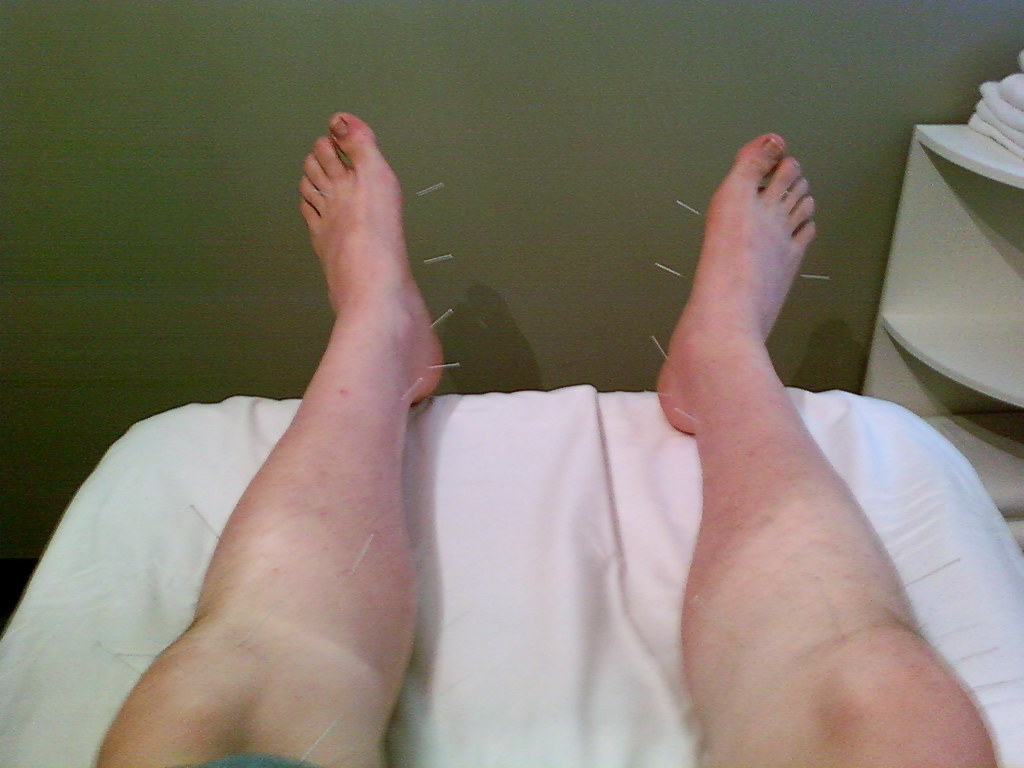
A 92-year-old who visited a neighborhood oriental medicine clinic for back pain died that same day. Of the three acupuncture needles the oriental medicine doctor inserted in the chest area, one reportedly went in too deep and caused a minute myocardial rupture inside the pericardium. According to a recent Money Today report, a single-judge panel of the Daejeon District Court sentenced the 68-year-old oriental medicine doctor, who had been indicted for occupational negligence resulting in death, violation of the Medical Service Act, and obstruction of business, to a fine of 20 million won.
The facts revealed in the article are as follows. The incident took place in August 2022 at an oriental medicine clinic in Sejong City. Although the patient complained of chest pain and difficulty breathing, the doctor took no particular measures for about 15 minutes, and the patient lost consciousness, was taken to a hospital, and ultimately died. The doctor reportedly did not take the patient's pulse, did not explain the risks of needling the chest area, and did not prepare a medical record. While finding the outcome grave, the court took into account that the defendant admitted the offense and reached an amicable settlement with the bereaved family.
Acupuncture is an all too familiar treatment for us. That is why many people wonder, "Can someone really die from acupuncture?" But the law applies the same yardstick to any medical act that puts the body at risk, whether Western or oriental medicine. Taking this case as an occasion, this column sets out how criminal and civil liability diverge in oriental medicine malpractice and what the victim's family should do first.
1. The Law Applicable to Acupuncture Accidents
A. Occupational negligence resulting in death
Article 268 of the Criminal Act provides that a person who causes the death or injury of another through occupational negligence shall be punished by imprisonment without labor for not more than five years or a fine not exceeding 20 million won. Treatment by an oriental medicine doctor is a typical form of 'occupation,' and if the patient died because the doctor breached the duty of care to be observed during the procedure, this provision applies. Considering that the maximum fine under this provision is 20 million won, it is clear that the fine of 20 million won in this case is by no means a light amount.
Negligence can be broadly divided into two branches. One is negligence in the procedure itself. In areas like the chest, where the lungs and heart lie just beneath, particular care must be taken with the depth and direction of the needle. The other is negligence in the response afterward. If time was allowed to pass without emergency measures or a transfer even though the patient complained of pain and difficulty breathing, that in itself raises a breach of the duty of care.
B. The duty to prepare medical records under the Medical Service Act
Article 22(1) of the Medical Service Act requires medical personnel to keep medical records and to record in detail and sign the patient's main symptoms, diagnosis, treatment, and so on. A violation is punishable under Article 90 of the same Act by a fine not exceeding 5 million won.
A medical record is not a mere administrative document. When an accident occurs, it is almost the only record showing at what site and to what depth the procedure was performed. Without a record, it becomes difficult for medical personnel to prove on their own that they fulfilled the duty of care, and the court may also view the absence of a record unfavorably.
2. Criminal Liability and Civil Liability Move Separately
A. Criminal liability faces the wall of 'causation'
To punish a medical accident criminally, it is not enough that there was negligence. A proximate causal relationship, meaning that the result occurred because of that negligence, must be proven. The Supreme Court made this principle clear in a case involving bee-venom acupuncture by an oriental medicine doctor.
Supreme Court Decision 2010Do10104, April 14, 2011Even if a doctor performed a medical act in breach of the duty to explain and an injury resulted, criminal liability for occupational negligence requires a proximate causal relationship between the injury and the breach of the duty to explain, and the same applies to oriental medicine doctors.
In that case, the Supreme Court upheld the lower court's refusal to find occupational negligence resulting in injury, reasoning that even if the explanation was insufficient, it could not be concluded that the patient would have refused the procedure had the explanation been given. Conversely, if, as in this Sejong case, there is an expert finding that the needle pierced the pericardium and caused a myocardial rupture, the link between the negligence in the procedure and the death becomes relatively clear.
B. The burden of proof is eased in civil liability
Civil damages are somewhat different. Because most of the medical process is known only to the medical personnel, the courts have built up legal principles that ease the patient's burden of proof.
Supreme Court Decision 93Da52402, February 10, 1995If the patient's side proves medical negligence based on the common sense of an ordinary person and proves that no cause other than the medical act could have intervened in the result, a causal relationship between the negligence and the result may be presumed unless the medical personnel prove another cause.
The same decision held that where the duty to explain was breached, consolation money for the patient's loss of the opportunity to choose can be claimed merely by proving that the explanation was insufficient. This is why, even if causation is denied in a criminal trial, there remains room for liability for consolation money and other damages to be recognized in a civil case.
3. What the Victim's Family Should Do Now
A. Secure the medical records first
Article 21 of the Medical Service Act provides that patients may request to inspect and obtain copies of their own medical records, and that where the patient has died, the spouse, lineal ascendants or descendants, and others may make the request by attaching a certificate of family relationship. As soon as possible after the accident, obtain the records from both the oriental medicine clinic and the hospital to which the patient was transferred. If you are told that there is no record at all, it is advisable to preserve that answer itself by text message or recording.
If the patient has died, an autopsy to determine the cause of death should also be considered carefully. Which organ the needle damaged, and how, is difficult to confirm without an autopsy and expert examination. The time of the procedure, the time the patient complained of pain, and the time the ambulance was called should also be organized using mobile phone call logs and the like. Just as the '15 minutes of neglect' became a key fact in this case, the chronological order determines the assessment of negligence.
B. Choose among a criminal complaint, mediation, and a lawsuit
Criminal proceedings begin with filing a complaint with an investigative agency. Death cases require expert examination, so investigations often take a long time. On the civil side, one can apply for mediation with the Korea Medical Dispute Mediation and Arbitration Agency or file a damages suit in court. Article 27 of the Act on Remedies for Injuries from Medical Malpractice and Mediation of Medical Disputes provides that in cases of death, mediation proceedings are to be commenced immediately even if the other party does not respond. However, an application for mediation is dismissed for a case in which a lawsuit has already been filed, so the order of steps must be chosen carefully.
C. Do not miss the deadlines
A claim for damages arising from a tort is extinguished by prescription if not exercised within three years from the date the damage and the tortfeasor became known, or ten years from the date of the tort (Article 766 of the Civil Act). An application for medical dispute mediation must likewise be filed within ten years from the date the act that caused the medical accident ended, and within three years from the date the damage and the tortfeasor became known. It is not uncommon in practice for people to miss the civil deadline while waiting for the criminal proceedings to end.
4. The More Familiar the Treatment, the More the Basics Must Be Observed
What stands out in this judgment is that the settlement greatly influenced the sentence. For medical personnel, organizing the records right after an accident and communicating sincerely with the bereaved family also carries important weight in criminal proceedings. Concealing an accident or altering records after the fact is expressly prohibited by Article 22(3) of the Medical Service Act and only makes the case more difficult.
Acupuncture and moxibustion have been with us for so long that their risks are easily taken lightly. But what the law ultimately demands of medical personnel is the same set of basics: check the patient's condition before the procedure, explain the risks, keep records, and if something goes wrong, provide emergency care and a transfer without delay. Had these four things been observed, the last day of the 92-year-old patient might have been different.
(Shin Dong-woo, Managing Partner, DAEON Law Firm)
This column provides general legal information based on Korean statutes and court decisions as of 2026. 10. 26.. It is not legal advice on any individual case.
2026. 10. 26. · By Attorney Dongwoo Shin
 Call
 KakaoTalk
 E-mail