
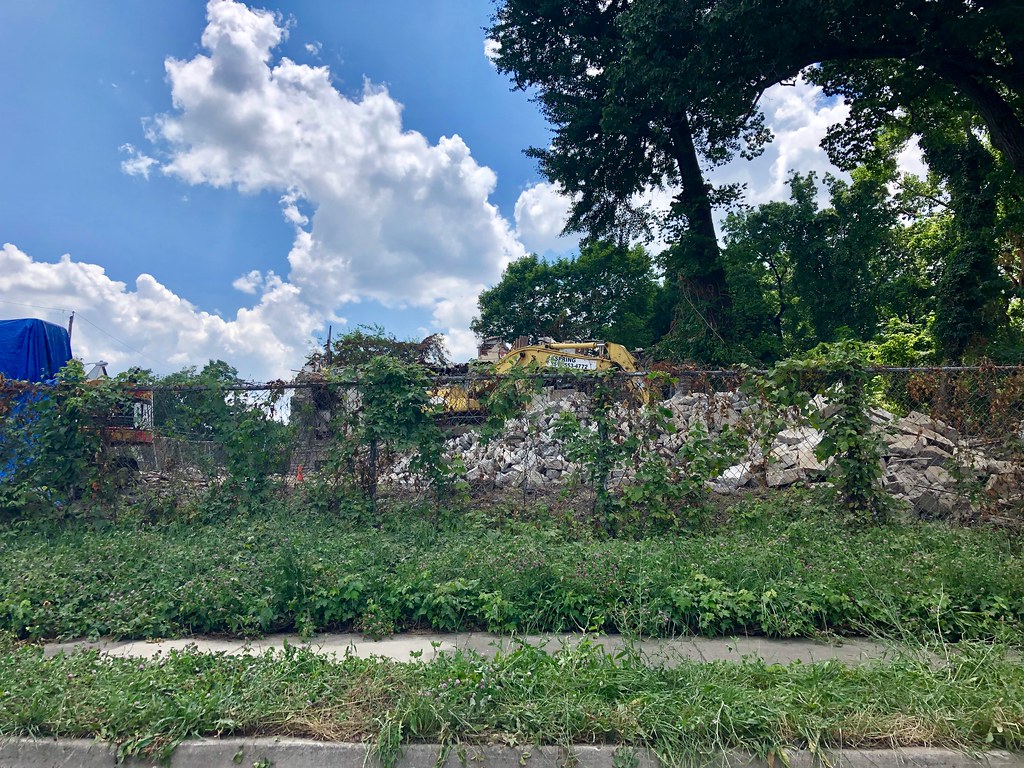
A country house bought for retirement disappeared entirely just before the owners were due to move in. According to reports by SBS's "News Hunters" and Money Today on the 12th, an elderly couple bought a house and land in Hongseong, South Chungcheong Province, for 55 million won in August 2024. They repaired the drainage system and septic tank, renovated the interior, and spent about 38 million won more, including on a TV, a refrigerator, and a bed. But while they were away for a few days, only rubble was left of the building, and the appliances and furniture had been smashed. Even the roof, the steel gate, and the heating oil stored for the boiler were reportedly gone.
The person who tore down the house was the paternal uncle of the former owner who had sold it. Having been in a dispute with his nephew over an inheritance, he allegedly brought in an excavator operator and demolished the house. The couple had already completed the registration of the transfer of ownership. He was sentenced last year in a criminal trial to six months in prison, suspended for one year, but nearly two years on, the house has not been restored. Instead, he reportedly valued the old building at 5 million won and offered that amount as a settlement. The couple are now paying monthly rent while pursuing a lawsuit for damages.
This case raises two questions. What crime is committed by tearing down someone else's house? And how much can the victims actually get back?
1. An Inheritance Dispute Cannot Justify Demolition
A. A house whose title has been transferred is no longer "family land"
From the perpetrator's point of view, there may have been a sense that it was "originally our family's land." But if he was dissatisfied with the inheritance, that was a matter to be fought out in court among the heirs. Directly destroying the house of a third party who has taken over the registered title cannot be justified on any pretext.
B. Crimes that may be established
Article 366 of the Criminal Act punishes a person who damages another's property and impairs its utility by imprisonment for not more than three years or a fine not exceeding 7 million won. A building is also property, so this provision applies. The same goes for smashing the appliances and furniture inside the house.
If scrap metal and oil were taken in the course of demolition, larceny (Article 329 of the Criminal Act, imprisonment for not more than six years or a fine not exceeding 10 million won) also becomes an issue, and if he entered within the fence of another's house, so does intrusion upon habitation (Article 319 of the Criminal Act). Damaging property while carrying a dangerous object constitutes special property damage (Article 369 of the Criminal Act), punishable by imprisonment for not more than five years or a fine not exceeding 10 million won.
C. Criminal punishment is a beginning, not an end
The reports alone do not reveal on what charges he was punished, but either way, criminal punishment is a beginning, not an end. A suspended sentence (officially “suspension of execution of sentence”) is only a punishment imposed by the State; it does not fill the victim's wallet.
2. Damages: Can They Recover the Full 93 Million Won?
A. The standard is the market value of the building at the time of demolition
Under Article 750 of the Civil Act, a person who intentionally destroys another's property must compensate for the resulting damage. The problem is "how much." The perpetrator's offer of 5 million won also appears to be a calculation aimed at this very point.
Supreme Court Decision 97Da39520, January 26, 1999
Where an object is damaged or destroyed, the cost of repair or the exchange value is the ordinary damage; where a building can no longer be used, the exchange value of the building is the damage; and where the cost of repair exceeds the exchange value, the damage is limited to the exchange value.
Under this legal principle, for the demolished building itself, "the market value of the building at the time of demolition" becomes the standard. For an old country house, the appraised value may not be high.
B. The repairs and household goods are assessed separately
However, the couple spent tens of millions of won repairing the drainage system and septic tank and renovating the interior. The appraisal should be based not on the old house as it was when purchased, but on its state just before demolition after the repairs were completed, which is why the repair records and photographs become decisive evidence. Movable property such as the smashed TV, refrigerator, and bed, as well as the missing oil and gate, can be claimed separately from the building at their respective values.
C. The price of the land is hard to include in the damages
Conversely, there are points the victims should also keep in mind. Of the 93 million won, the price of the land reflects the value of land that still remains. If the land is intact, it is difficult to regard the entire purchase price as damage. Building up the claim accurately item by item is far more persuasive in court than inflating the figures.
3. Compensation for Non-Economic Damages and "Special Circumstances"
A. The principle on compensation for non-economic damages for property damage
No one would dispute that the elderly couple who lost their home suffered a great sense of loss. But courts do not readily award compensation for non-economic damages for property damage.
Supreme Court Decision 2003Da22912, July 25, 2003
Where property rights are infringed, absent special circumstances, mental suffering is deemed to be remedied by compensation for the property damage; however, where there is mental damage that cannot be remedied by that alone, compensation for non-economic damages may be awarded.
B. Circumstances that can be asserted in this case
This case leaves considerable room to assert such "special circumstances." A dwelling prepared for people to live in was intentionally demolished in its entirety, and threats had reportedly continued before that, such as posting warning notices and leaving filth in front of the gate. Overnight, the victims had to move into someone else's house and pay rent. It must be shown through concrete facts that this is different in kind from simple damage to objects.
C. Rent and moving costs
In the same vein, the monthly rent paid while living elsewhere after the demolition and the moving costs can also be argued as items of damage.
4. What Victims Should Secure Now
A. Obtain the criminal judgment
Facts found in the related criminal judgment, absent special circumstances, serve as strong evidence in a civil trial as well. In many cases, the victim need not prove from scratch who destroyed what and when.
B. Organize the damage item by item
Even if the market value of the building is determined by appraisal, the victims must personally collect the repair construction contracts and receipts, purchase records for appliances and furniture, photographs before and after the demolition, oil purchase records, and the like. These are materials that disappear over time.
C. Tie up the perpetrator's assets first
Even with a judgment, there is no way to enforce it if there are no assets in the other party's name. In practice, provisionally attaching the other party's real estate or deposits even during the lawsuit is as important as the judgment itself.
D. Check whether anyone else shares the liability
If the operator who actually ran the excavator knew, or could easily have known, that it was someone else's house, it is worth examining whether he can be held jointly liable as a joint tortfeasor under Article 760 of the Civil Act.
E. Do not miss the extinctive prescription period
Under Article 766 of the Civil Act, a claim for damages arising from a tort is extinguished by prescription after three years from the date the victim became aware of the damage and the perpetrator, or ten years from the date of the tort. It is different where, as with this couple, a lawsuit has already been filed, but in reality it is not uncommon for people who suffer similar harm to let the period lapse while waiting only for the outcome of the criminal case.
5. The Distance Between Criminal Punishment and Recovery of Damage
The most frustrating part of this case is that the damage remains untouched even after the perpetrator was punished. In our system, criminal and civil trials move separately, and even after the criminal trial ends, the victim must again file a lawsuit, go through an appraisal, and carry out enforcement on his or her own. In the meantime, the victim spends years of time and money.
In property crimes with clear amounts of damage, such as property damage, recovery of the victim's loss needs to be addressed more actively within criminal proceedings. Victims, too, can greatly shorten the later civil proceedings by organizing evidence and damage records from the investigation stage.
One day was enough to tear down someone else's house, but getting it back is taking years. The law should shorten that time, even a little.
(Shin Dong-woo, Managing Partner, DAEON Law Firm)
Photo: w_lemay, CC0 Public Domain (Openverse)
2026. 10. 14. · By Attorney Dongwoo Shin
 Call
 KakaoTalk
 E-mail