

-
About DAEON

-
Our Team
-
Practice Areas
-
Case Results
-
Resources
-
Contact Us
 Back
BackCriminal · School Violence · Damages
Cooperative Chairman Indicted for False Accusation over an 'Allegedly Fabricated Complaint'
1. Case Overview
In this false-accusation case, the defendant, chairman of a regional cooperative and the final decision-maker on its lending, was indicted for allegedly filing a false criminal complaint in connection with certain apartment sale contracts. His complaint alleged that the developer's representative and its actual operators had drawn up sham sale contracts for apartments that had never actually been sold and defrauded the cooperative of roughly KRW 8.2 billion in interim-payment loans. The Prosecution, however, took the view that the defendant had engaged in numerous similar transactions with the developer over the years and knew the contracts were sham, yet deliberately disregarded this and filed a fraud complaint in order to have the other party criminally punished, and indicted him for false accusation. The defendant maintained that his intent was not to make a false accusation but reflected good-faith trust and judgment; still, a false-accusation charge is a grave matter that can inflict devastating reputational damage from the moment of indictment.
2. DAEON's Strategy
DAEON focused on proving that the defendant had no intent to file a false complaint. Defense counsel presented past instances in which the defendant had successfully recovered loans without loss in similar transactions involving sale contracts, emphasizing that he had no motive to press criminal charges while knowing the transaction to be fraudulent. We also explained in detail how the defendant had filed the complaint as a straightforward business judgment grounded in a long-standing dealing relationship with the developer, and highlighted that the complaint rested on his actual understanding and judgment at the time rather than any deliberate distortion of the facts. As a result, the court found that 'the evidence submitted by the prosecutor is insufficient to establish intent to make a false accusation' and acquitted the defendant. This outcome, the product of strategically organizing the evidence from the outset and logically persuading the court that the defendant's conduct was a normal business act, stands as a representative example of a successful defense against an unjust false-accusation charge.
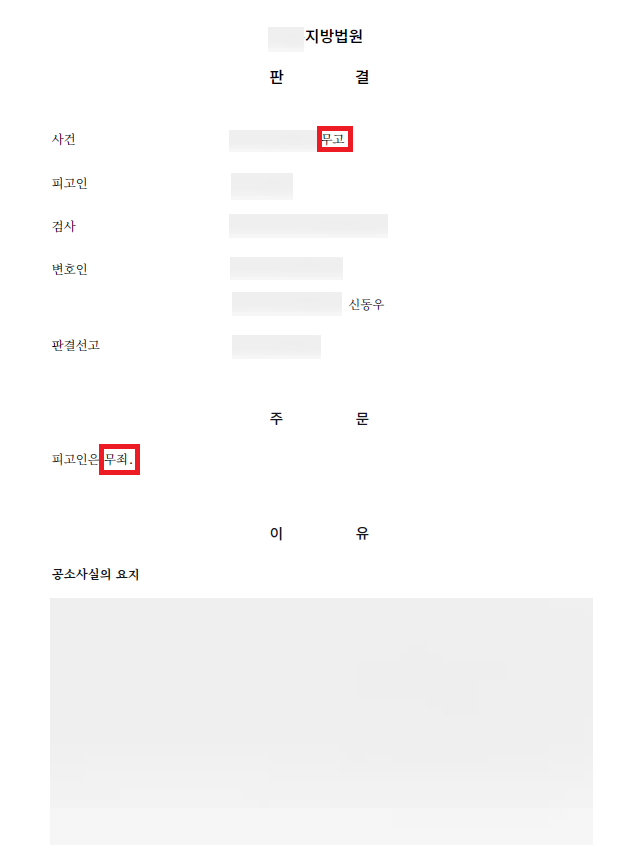
3. Result - Acquittal
Shin Dong-woo