

-
About DAEON

-
Our Team
-
Practice Areas
-
Case Results
-
Resources
-
Contact Us
 Back
BackCriminal · School Violence · Damages
Victim Representation — Deepfake Distribution Case; Prison Sentence for 'Obscene Acts via Telecommunications and Defamation'
1. Case Overview
The defendant superimposed the victims' faces onto nude photographs, or posted them alongside obscene captions, hashtags, and their real names, and distributed them on social media dozens of times. This conduct, a so-called 'deepfake sex crime,' caused the victims severe shame, humiliation, and anxiety, leaving them unable to carry on even ordinary social lives.
Notably, some of the defendant's targets included the faces of actual acquaintances and former classmates, and the severity, repetition, and deliberateness of the posted content were plainly evident.
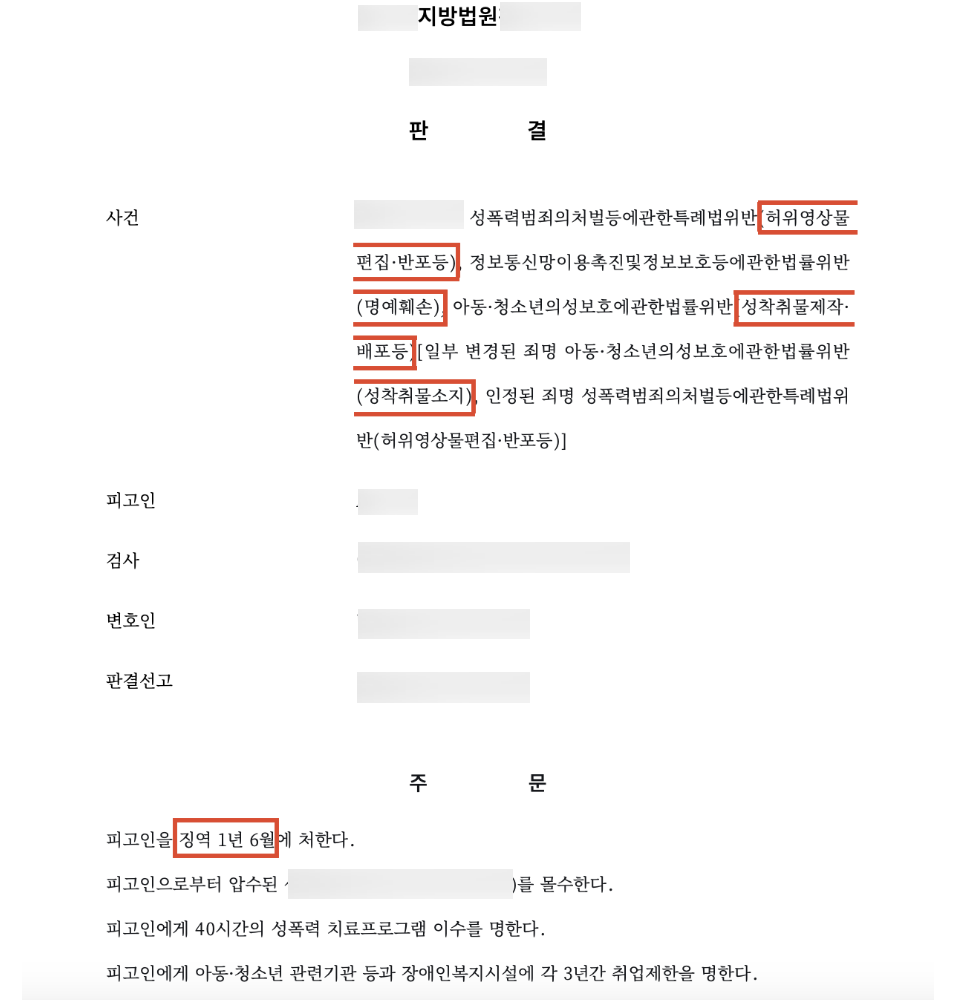
The court found that the defendant's conduct constituted Obscene Acts via Telecommunications and defamation, and gave serious weight to the fact that he had previously served a prison sentence for a sex offense yet committed the same type of offense during the repeat-offender period. As a result, the defendant was sentenced to one year and six months in prison, ordered to complete 40 hours of a sexual violence treatment program, barred from relevant employment for three years, and the mobile phone used in the offenses was confiscated.
2. DAEON's Strategy
The victim came to me suffering severe anxiety and panic symptoms from the shock of having sexually humiliating images distributed online to an unspecified audience. From the outset, I built a legal strategy to ensure the victim's feelings and rights would be fully reflected throughout the trial.
At the investigation stage, I organized the evidence around forensic data and captures of the posts to prove that the defendant had actually created and distributed the composite images; at the trial stage, I submitted an opinion brief detailing the defendant's repeat-offender history, his complete lack of any attempt at making amends, and the victim's psychological suffering.
I further emphasized that the defendant never apologized to the victim or made any restorative gesture, and that the victim remains unable to carry on a normal social life to this day out of fear of exposure, leading the court to impose a prison sentence.
Digital sex crimes such as deepfake offenses in particular do not end with a single act of distribution; they readily lead to ongoing secondary harm, which makes the initial response and settlement strategy critically important. A victim who responds emotionally or enters into an unprofessional settlement risks losing both the effectiveness of criminal punishment and the opportunity for recovery.
Just as I thoroughly protected the victim's rights and secured a prison sentence for the perpetrator in this case, I will continue to do my utmost in the legal and strategic handling of similar cases.
3. Result - 1 Yr 6 Mo Prison
Shin Dong-woo