

-
About DAEON

-
Our Team
-
Practice Areas
-
Case Results
-
Resources
-
Contact Us
 Back
Back
[DAEON Law Firm] 'Review Manipulation Rings' Prey on Side-Hustle Seekers; a Five-Star Rating Fetches Just 1,000 Won [Exclusive]
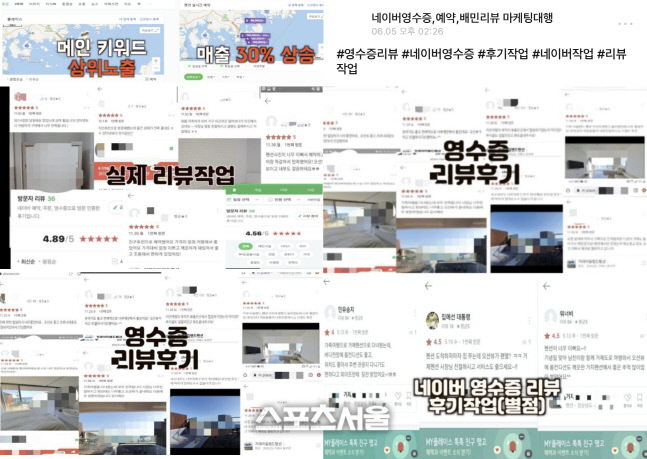
[Sports Seoul News | Reporter Yang Mi-jeong] As the number of consumers who open their wallets only after checking review content, review counts and star ratings surges, 'review manipulation' has become rampant as well. Write a five-star, all-praise review, then tap the 'save store' and 'wishlist product' buttons, and 1,000 won lands in your bank account. Because review manipulation can be done through multiple or borrowed accounts without any verification, it is spreading at an alarming pace.
With the dawn of the 'review-is-everything' era, so-called 'value reviews' (reviews that emphasize performance relative to price) have emerged as a key benchmark. Whether eating out, visiting a hot spot, going to a hair salon, ordering delivery or shopping online, checking a platform's 'reviews' section has become an essential step. Places and products whose reviews or ratings fall short of expectations are simply left out. Even when price and performance are excellent, a business with few reviews is easily misread as 'unpopular or low quality.'
Platforms that read this psychology well have rushed, one after another, to introduce review features. Businesses that secured an overwhelming number of reviews, high ratings and a wall of glowing 'positive comments' thrived. A structure took hold in which the top predator, the business sitting at the top when sorted by most reviews or highest rating, walks away with the lion's share of revenue.
As a climate spread in which consumers would blindly trust anything armed with the powerful weapons of reviews and ratings, even if it was a little pricier or performed a little worse, businesses resorting to tricks began appearing one by one. They went beyond asking acquaintances for favors and started seeking out specialized agencies to request review manipulation. As fake reviews flooded in, the market ecosystem was thrown into disarray, to the point where anyone who did not manipulate reviews was treated as a fool. Now out in the open, review manipulation has hardened into standard practice.
In fact, an analysis of several hundred review-manipulation requests collected from a review-manipulation agency's KakaoTalk open chat room between the 14th and 21st found that 80 percent of all orders were requests to manipulate Naver reviews (Naver Place, Smart Store and the like). Baemin (10 percent), Coupang (5 percent) and Wadiz (2 percent) followed in that order. This is why the same restaurant can show such a wide gap in ratings, 4.9 on Naver and 3.3 on Daum, for instance.
On Naver, searching for 'review agency' surfaces a range of review-manipulation agencies at the top of the results as sponsored Power Links. The agencies entice small business owners by claiming that 'the quality is different from ordinary reviews, because a company that reflects customer feedback writes the heartfelt reviews itself.' In reality, however, anyone could enter the KakaoTalk open chat room at any time, from anywhere and without restriction, and contrary to the advertised copy, the review manipulation was being carried out through an unspecified mass of participants.
Marketers enter group chats populated by roughly 1,000 anonymous members and post instructions on how to manipulate reviews and ratings, how to inflate review counts using multiple accounts, and a promise to pay 1,000 won for the labor. The agency charges the business owner 5,000 won per review. Of that, the agency keeps 4,000 won and pays the reviewer only 1,000 won, but for students short on pocket money, office workers dreaming of a side hustle and homemakers interested in a second income, it adds up to a tidy sum.
When a participant enters the open chat room and tells an agency staffer they want to take part, they are sent a guidance message. If the address, mobile number and IP address differ, several accounts can be used at once. The participant buys the product with their own money, enters a review tailored to the agency's liking along with a five-star rating, and is paid 1,000 won. The rules are fairly strict and complicated. A single slip can mean losing not only the payment for the work but also the purchase price invested. Yet the agency flatly states, 'No inquiries accepted for mistaken purchases.' Given the nature of open chat, cases in which the agency simply vanishes are countless.
Using two accounts on Naver, this reporter booked hair treatments at Salon A priced at 330,000 won and 260,000 won respectively. Writing 'This is a booking for a review' in the request field got the booking rejected. After the agency asked whether this was my first time doing review work and told me to do it properly, I changed the note to 'Please make my hair pretty,' and the agency approved the 'fake' booking.
Once the booked time slot has passed, the conditions for writing a review are met. I praised the salon, saying I was 100 percent certain to return and that the quality, price and service were all superb. Nor did I forget the five-star rating. A representative of Salon A, which had traded 5,000 won for a quality review, replied as though the reporter had actually visited: 'Thank you for visiting our shop during these anxious and worrying times. We will continue to maintain a safe and clean environment.'
The problem is that reviews manipulated in this way harm both consumers and honest business owners in the same trade. For owners falling behind in the review race, the temptation to manipulate is hard to resist. Mr. B, who runs a Japanese restaurant, lamented: 'For the past 30 years I took pride in winning customers over purely on taste, portions and price and in earning satisfying sales, but recently COVID-19 has caused my sales to plunge. Taking advantage of that, agencies keep approaching me one after another, urging me to boost sales through review manipulation. In the past I would have turned them down as absurd, but with my livelihood on the line, I feel like grasping at straws.'
Because review manipulation falls under the Criminal Act's offense of obstruction of business, or obstruction of business by damaging computers or similar means, both the business that requested it and the individuals who took part are subject to punishment. It can carry a prison term of up to five years or a fine of up to 15 million won. Attorney Shin Dong-woo of Shinhan Investment Corp. warned, 'There has recently been a case in which a defendant was sentenced to 10 months in prison over a similar matter. If economic gains were obtained through the manipulation, confiscation and forfeiture are also possible.'
The Fair Trade Commission also imposes an administrative fine of up to 10 million won for violations of Article 21, Paragraph 1, Item 1 of the E-Commerce Act (the act of luring or transacting with consumers by announcing false or exaggerated facts or by using deceptive means, or obstructing withdrawal of subscription or termination of a contract).
Rep. Bae Jin-kyo, floor leader of the Justice Party, who recently sponsored an amendment to the E-Commerce Act to toughen penalties for fake reviews, argued: 'Platforms are not bystanders when it comes to review manipulation. They must fulfill their responsibility to prevent it. To establish a fair trading order online, the practice of paying for reviews must be prohibited.'
The amendment to the E-Commerce Act would, among other things, require online sales intermediaries (platform operators) to secure transparency by disclosing information such as how user reviews are collected and how they are sorted; insert a warning that writing false user reviews is punishable; and require preventive measures against the writing of false user reviews and against brokering or arranging such reviews. Violations of the prohibited acts would be punishable by up to three years in prison or a fine of up to 100 million won, with enhanced punishment where an intent to cause detriment is found.
'Unless we change the current structure in which everything is judged by reviews and star ratings alone, the problem will keep repeating,' Rep. Bae stressed. 'We need to impose responsibility on the platform companies that operate these systems to come up with improvements, while at the same time regulating by law acts such as manipulating reviews falsely in exchange for payment and demanding payment in return for writing reviews.'
https://www.sportsseoul.com/news/read/1086438?ref=naver
57 clicks